Bounce Boost
A gamified loyalty and referral system designed to drive daily engagement and long-term retention for fintech platform Bounce Pay.
- Role
- Product Designer
- Team Members
- Team of 4
- Project Length
- 1 week
- Tools
- Figma, UX/UI, Research
This page is a work in progress :)
Slide Deck
Overview
Bounce Boost is a product growth architecture designed for the fintech platform Bounce Pay to address the friction between young adults' social lives and the awkward experience of splitting group expenses. The goal was to build a high-activation referral system and a gamified loyalty interface that prioritizes viral loops and habit formation, allowing users to settle payments while unlocking community rewards. By centralizing verified bank onboarding, action-driven challenges, and local raffle tiers into a high-engagement mobile interface, the strategy aims to serve university students who value lifestyle-integrated, social P2P utility over traditional, purely functional banking applications.
Context and Mandate
In Canada's digital banking landscape, peer-to-peer (P2P) payment systems lack social experience, lifestyle integration, and gamification. Tasked with accelerating network growth for fintech startup Bounce Pay, our team designed a growth system targeting university students and young adults to build long-term retention, viral loops, and organic habit formation.
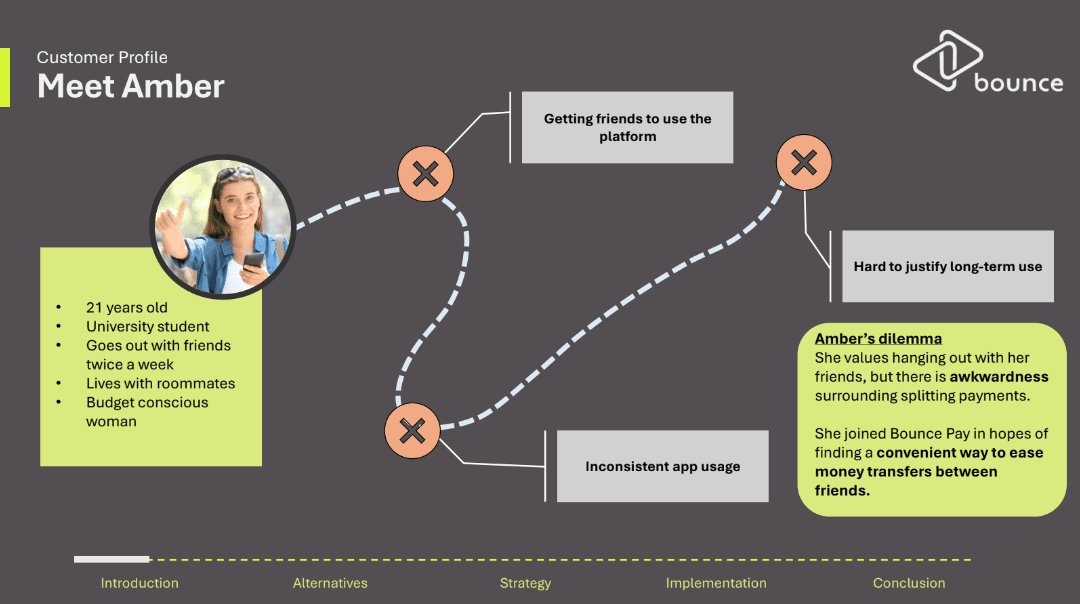
Persona: Amber
Amber is a university student that values hanging out with her friends, but there is awkwardness surrounding splitting payments. She joined Bounce Pay in hopes of finding a convenient way to ease money transfers between friends.
Demographics: Female, 21 years old, located in Montreal (Canada) Education: University student
Traits and lifestyle:
- Tech-literate person
- Lives with roommates
- Budget-conscious
- Goes out with friends twice a week
Pain points:
- Getting friends to use Bounce
- Inconsistent app usage
- Hard to justify long-term use
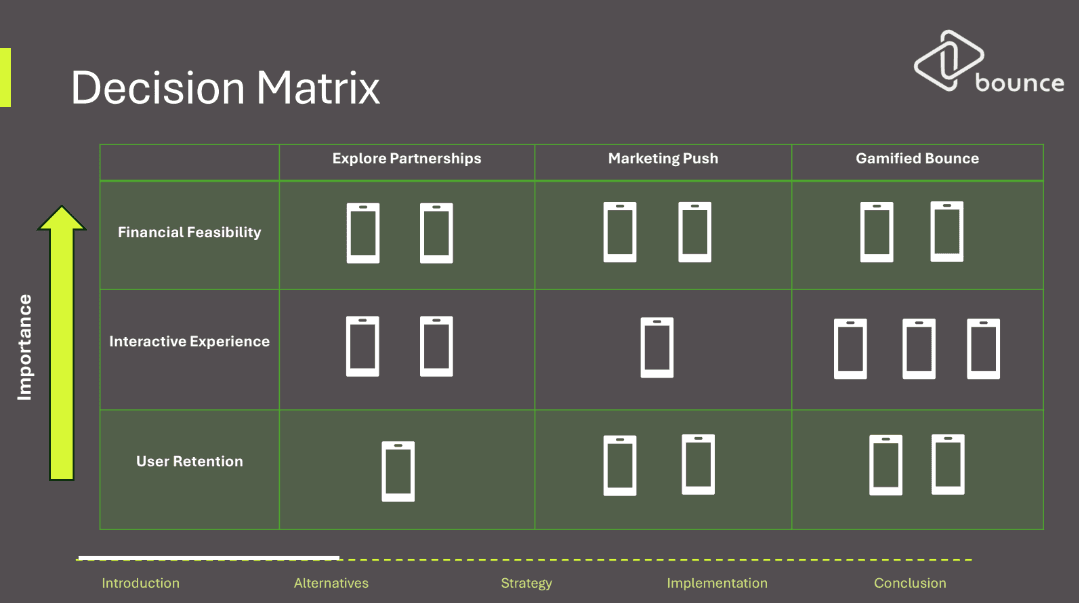
We considered many strategies to battle this problem…
Alternative 1: Explore Partnerships
This strategy centered on establishing structural alliances, specifically targeting integrations with local merchants or existing university infrastructure.
- The Good: Offered strong credibility and direct, structured access to large student populations.
- The Trade-off: While financially feasible over a longer horizon, it scored poorly on providing an immediate, interactive experience for individual users and required significant negotiation time to impact daily retention.
Alternative 2: Marketing Push
This alternative focused on a traditional, capital-intensive acquisition campaign through standard digital and on-campus promotional channels.
- The Good: Highly straightforward to deploy and effective for building quick brand awareness.
- The Trade-off: This option suffered from poor financial feasibility due to high client acquisition costs. It failed to address the systemic Interac inertia or product-level retention, as it lacked any interactive mechanism to build long-term user habits.
Alternative 3: Gamified Bounce (The Winning Strategy)
This pathway involved embedding an active, incentivized layer directly into the core UX/UI to gamify routine peer-to-peer expense settlements.
- The Good: It scored exceptionally high across all three decision criteria. By combining a high-activation referral loop with the Bounce XP engine, it achieved a highly optimized customer acquisition cost while natively driving recurring daily interaction and sustainable long-term retention.